A Dutch artist friend of mine, Daan Samson, has created a series of installations he calls “prosperity biotopes”. Though executed in various mediums, they share a unifying theme: the harmony of pristine nature and cutting-edge technology. At his exhibition in Amsterdam, I spotted ants scuttling on an ant plant alongside a sleek steel Nespresso milk frother, its presence as enigmatic as the black monolith from 2001: A Space Odyssey.
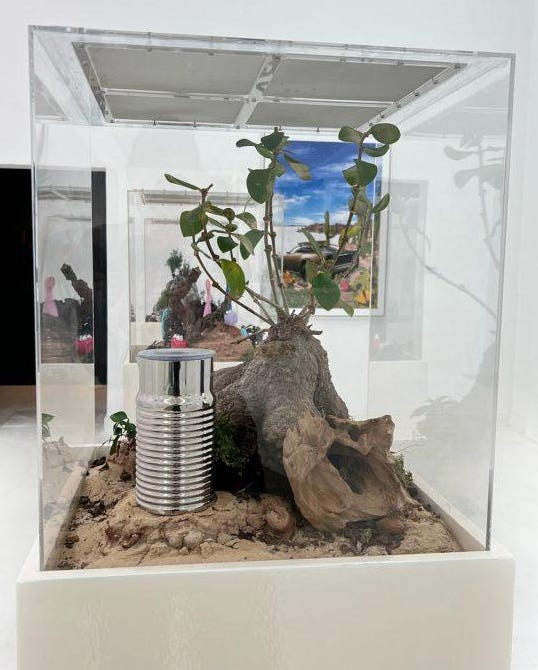
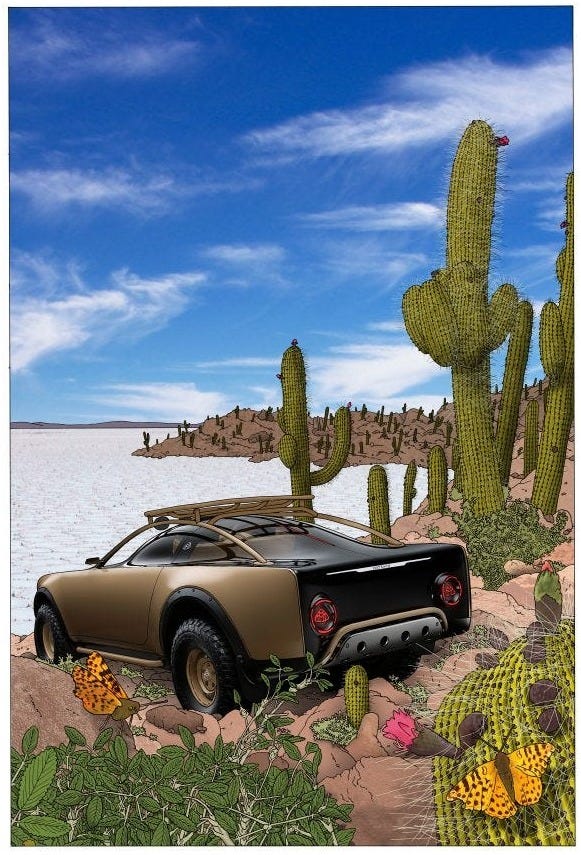
Then there was this drawing on the wall showing a shiny electric dream car from Mercedes-Benz, parked on a Bolivian salt flat and flanked by sturdy cacti.
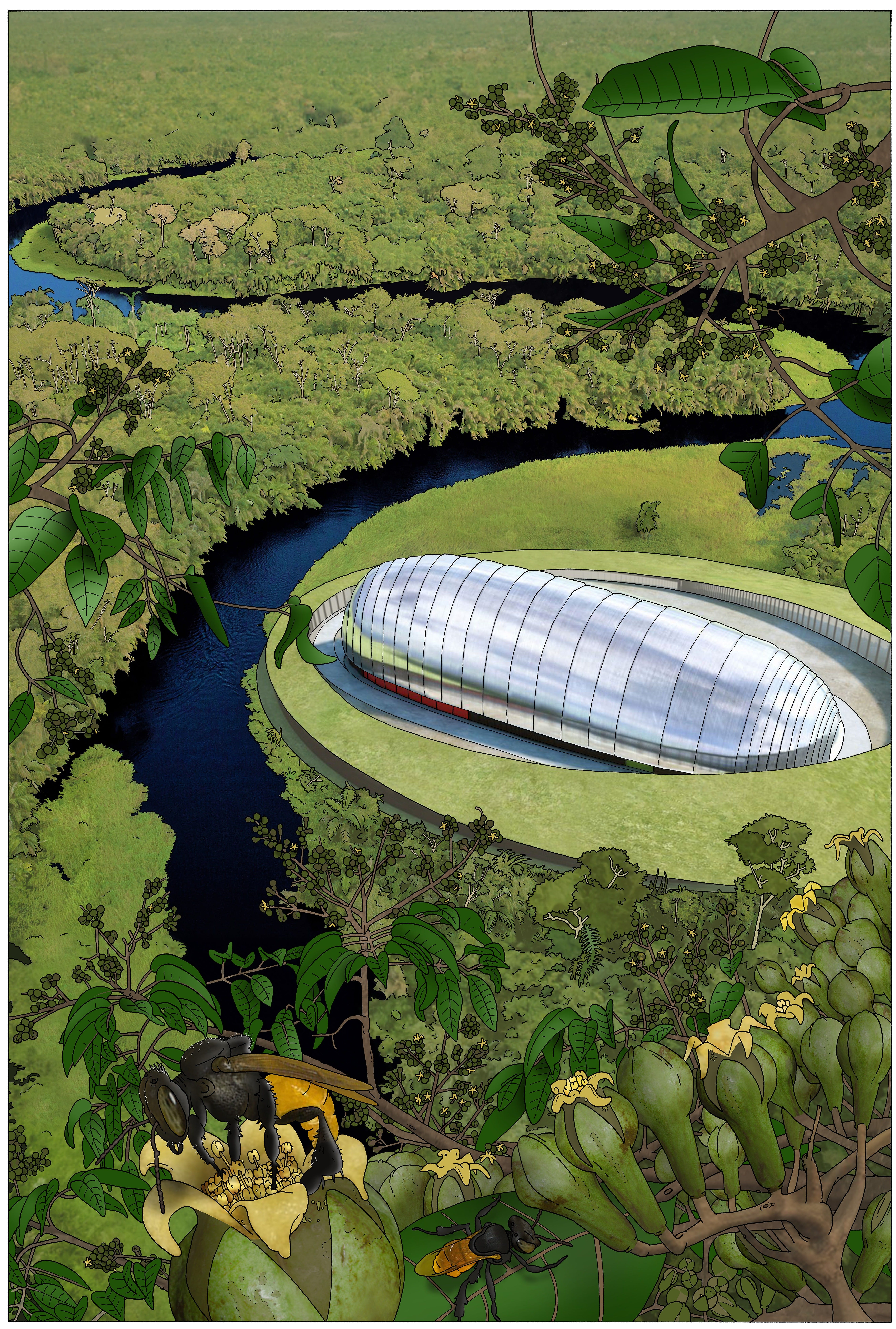
As an unabashed nuclear bro, I have to say my favorite prosperity biotope featured a futuristic small modular reactor (SMR) by Rolls-Royce, nestled deep in the Congo Basin rainforest. Its sleek, hulking form resembles a steel caterpillar, glistening scales half-buried in the earth, like a metallic version of Frank Herbert’s giant sandworms in Dune. It’s the kind of utopian vision ecomodernists love: high-density technology surrounded by untouched natural beauty.
By fusing the natural and the artificial, Samson invites us to think about the relationship between civilization and wilderness. Must we choose between the splendor of wild nature and the marvels of cutting-edge technology, between majestic redwoods and soaring skyscrapers? Or is it possible to have our cake and eat it too?
Even more striking than Samson’s prosperity biotopes were the reactions from the art world. Some curators and art critics assumed his art had to be ironic and subversive. Was he slyly mocking our consumer culture and its tacky product placement? Or was he calling out the encroachment of technology on Mother Nature? And wasn’t there a hint of capitalism critique beneath the surface? Art experts couldn’t wrap their heads around the notion that Samson’s work carried a sincere, non-ironic message: we don’t have to choose between nature and comfort—we can totally have both.
When Samson applied for subsidies from the city of Rotterdam, he got an unintentionally hilarious response. The city’s cultural committee had decided that his art project was “preposterous.” Why? They felt that the artworks “lacked critical reflection” and would have much preferred a “socially critical perspective on welfare.” Loosely translated: if you want to make art in a 21st-century European welfare state, your work better attack modern welfare, technology, and consumerism. And if you’re hoping to snag some government subsidies—milk from the capitalist cash cow—then you’d better declare yourself an enemy of capitalism.1 An insolent artist celebrating modern technology and consumption? No dosh for this buffoon!
Subscribe here—let’s make optimism about the future cool again.
What happened?
As a believer in progress, I’m loath to admit that anything was better in the past. After all, as the American journalist Franklin P. Adams once said, “Nothing is more responsible for the good old days than a bad memory.” But in recent years, I’ve reluctantly started to recognize that something has really changed for the worse. Pessimism and doom-mongering have always been with us, but over the past half century we seem to have completely soured on the idea of progress. Even so-called “progressives”, as I write in my book The Betrayal of Enlightenment, have turned their backs on progress. Socialists like Karl Marx and Sylvia Pankhurst dreamed of a world of abundance for all and infinite growth, celebrating plentiful energy and denouncing the scarcity mindset. By contrast, many progressives today warn that economic growth is a dangerous fetish, that “technofixes” won’t save the climate, and that the best energy is the “energy not consumed.”2
Plotting the evolution of the Zeitgeist is no easy task, but
John Burn-Murdoch from the
Financial Times has recently made a valiant effort. If we look at the frequency of terms related to progress, improvement and the future over time, we see a decline by about 25% since the 1960s, while “those related to threats, risks and worries have become several times more common”.
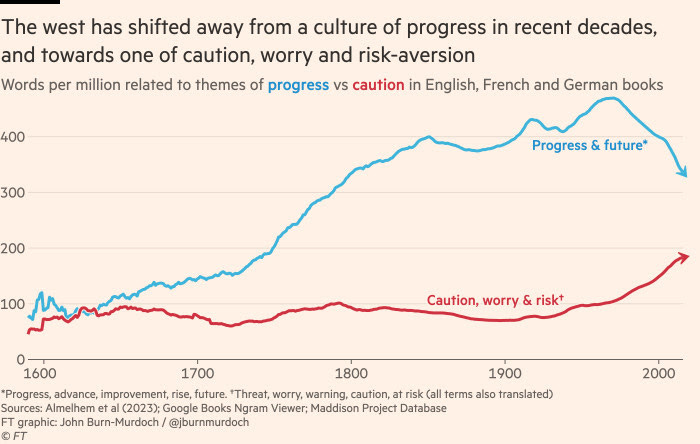
And indeed, the arts seem to reflect this waning belief in progress. If you dive into the art and popular culture of the past, it seems our ancestors were genuinely more optimistic about the future and more confident in modernity. At least our recent ancestors—because belief in progress is itself a recent invention.
How belief in progress started
The belief in progress started to take shape in Europe from the eighteenth century onwards, when the steady accumulation of knowledge and innovation first became noticeable within the span of a single generation. For the first time, history felt like an arrow pointing forward: new innovations built on the old ones, and the old ones were never lost again. This naturally raised the question: how much better could the future be?
Dreams of paradise were not new, but they had usually been imagined as a golden age in the distant past. Now, for the first time, people began to believe that human ingenuity itself could create a perfect—or at least vastly better—society in the future. If human knowledge continues to expand, our descendants will surely live in a world of abundant prosperity, freedom, and beauty. The first futurists were, not coincidentally, also pioneers of the scientific revolution. In his 1626 book New Atlantis, published posthumously, the English philosopher Francis Bacon describes a society on the fictional island of Bensalem in the Pacific Ocean. The harmonious community on this island is centered around the House of Solomon—a kind of research institution dedicated to investigating the world to obtain useful knowledge that can improve the lives of its inhabitants. The Bensalem islanders excel in “generosity and enlightenment, dignity and splendor, piety and public spirit.”3
[Read the rest of this piece on my Substack]