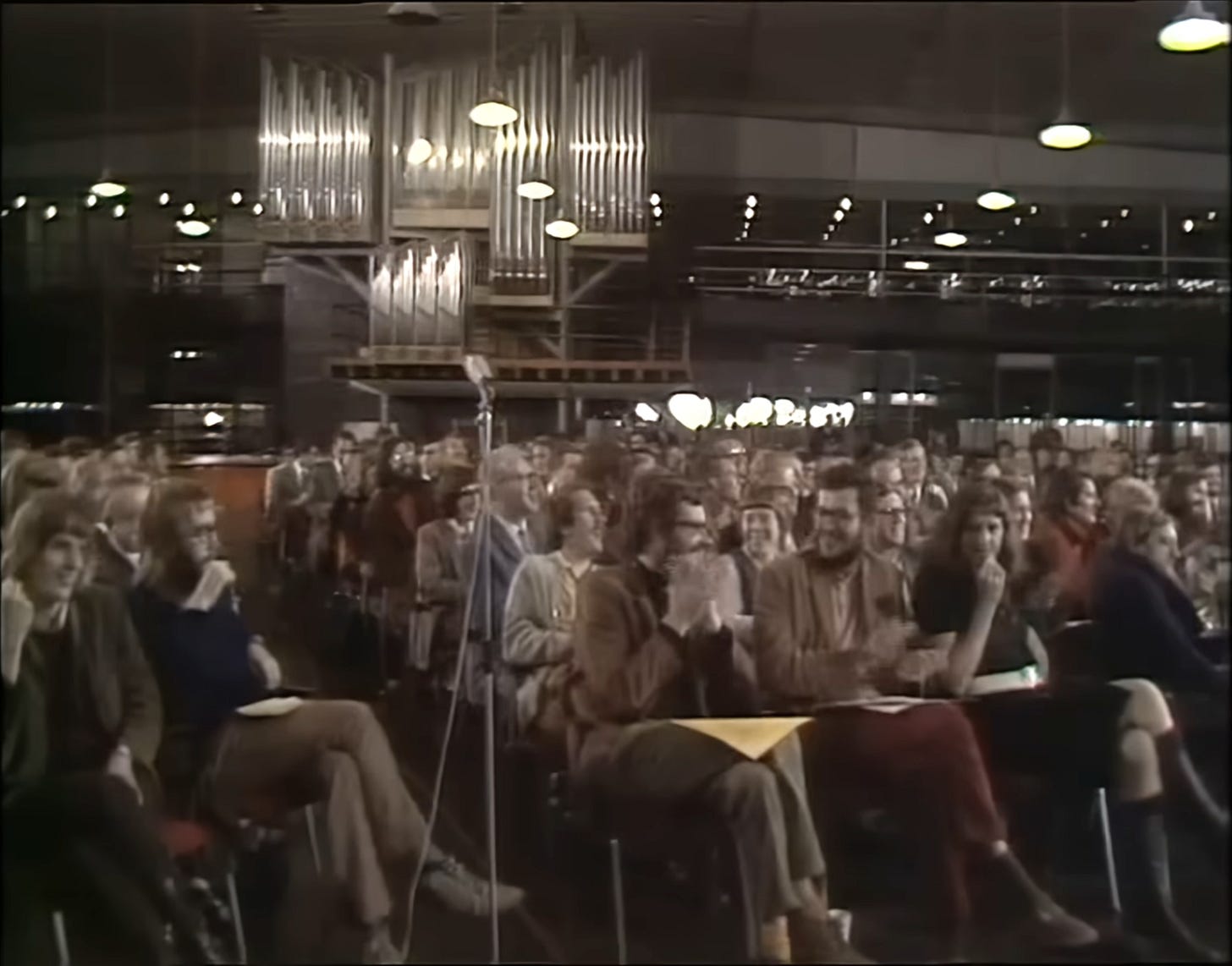
On an autumn evening more than half a century ago, in 1971, a television crew set up their equipment in the auditorium of the University of Technology in Eindhoven. The imposing Pels & Van Leeuwen organ, purchased by the Dutch electronics giant Philips, towers over the hall in the background. There are dense rows of folding chairs, with students and academics waiting impatiently for the main event. At a glance, you can see which era we’ve landed in: oversized glasses, unkempt hair, luxuriant beards — the audience is predominantly male. You can smell the scent of revolution in the air, and that’s no accident. The United States is mired in a deeply unpopular war in Vietnam, bringing tens of thousands of young protesters into the streets, on European campuses as much as in America. Here in Eindhoven, radical students and faculty are gathered for what will prove to be a singular confrontation between two titans of the progressive vanguard.
Moments later, they sweep down the stairs and take their seats in two modernist armchairs on a small podium. Their names are Michel Foucault and Noam Chomsky. One is a French philosopher from the Collège de France in Paris, flamboyant and openly homosexual, who rose to fame with a series of books on the intertwining of power and knowledge. The other is a Jewish-American linguist at MIT in Cambridge, a pioneer of generative grammar and a relentless critic of American imperialism.
Even half a century ago, Foucault and Chomsky were already regarded as leading progressive thinkers; since then, their reputations have only grown. Although Foucault’s career was cut short by his death from AIDS in 1984, he remains to this day the most-cited author in the social sciences. Noam Chomsky, meanwhile, has arguably been the most influential left-wing thinker in the world for decades — not least because his French rival was no longer around.
The official topic that night was an age-old philosophical chestnut: “Is there such a thing as ‘innate’ human nature independent of our experiences and external influences?” The moderator was Fons Elders, a young Dutch philosopher and Marxist whose long hair and full beard were perfectly in tune with the prevailing fashions. Chomsky was the only one on stage sporting a tie; Foucault was clad in his signature turtleneck under a stylish jacket, his bald head gleaming under the spotlights.
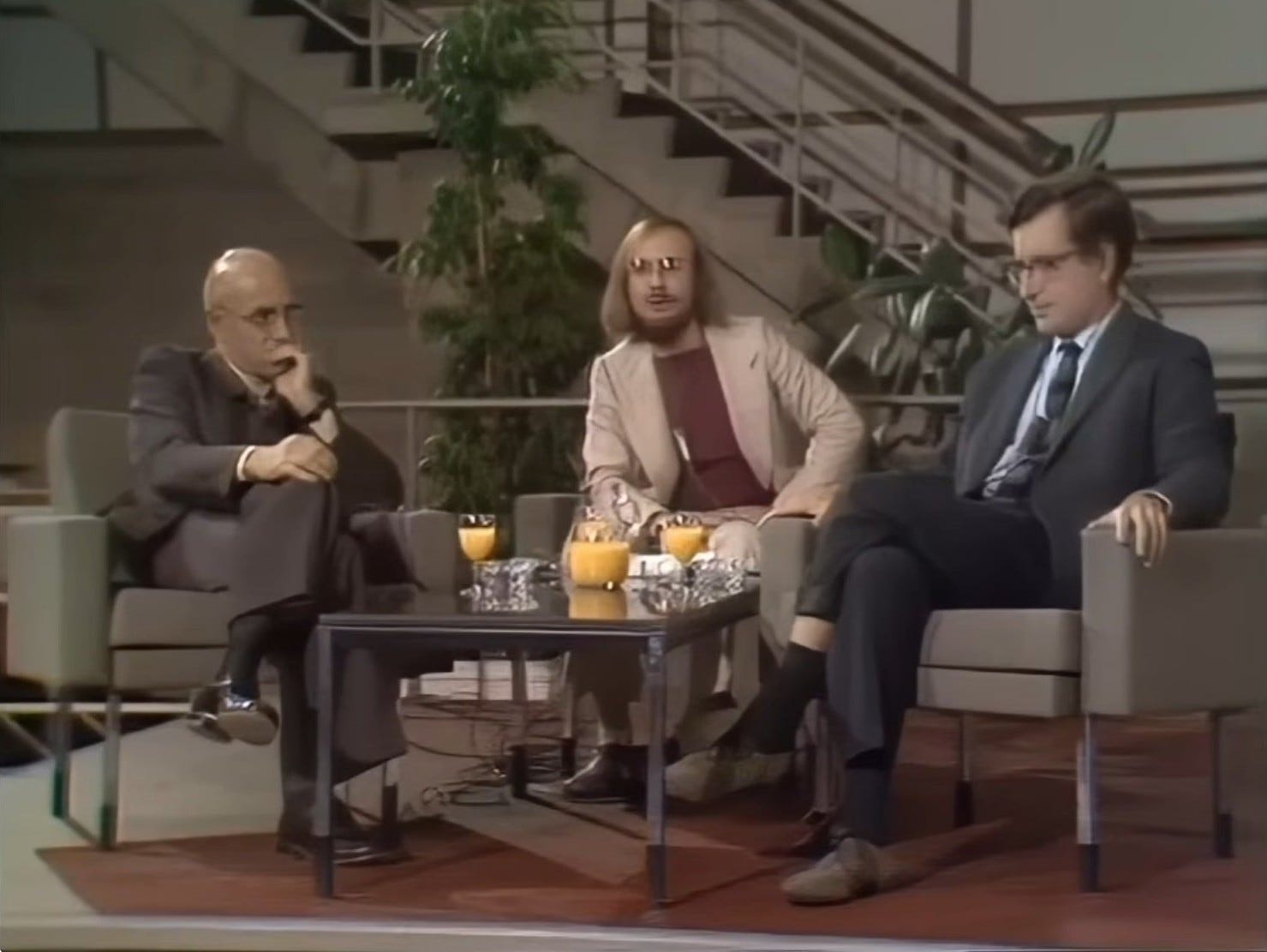
It was the very first time the two heavyweights entered the ring, and they would never do so again. Getting them to this point, the moderator later recalled, had cost him no small effort. During the preliminary meetings, Foucault in particular was cagey and full of mischief. Little did the strait-laced Chomsky know that, as part of the French philosopher’s fee, Fons Elders had procured a hefty portion of hash from the streets of Amsterdam. Months later, Foucault and his friends were still sniggering about the “Chomsky hash” they had smuggled into Paris. If Foucault relished anything, it was trampling bourgeois morality and seeking out “transgressive experiences.”
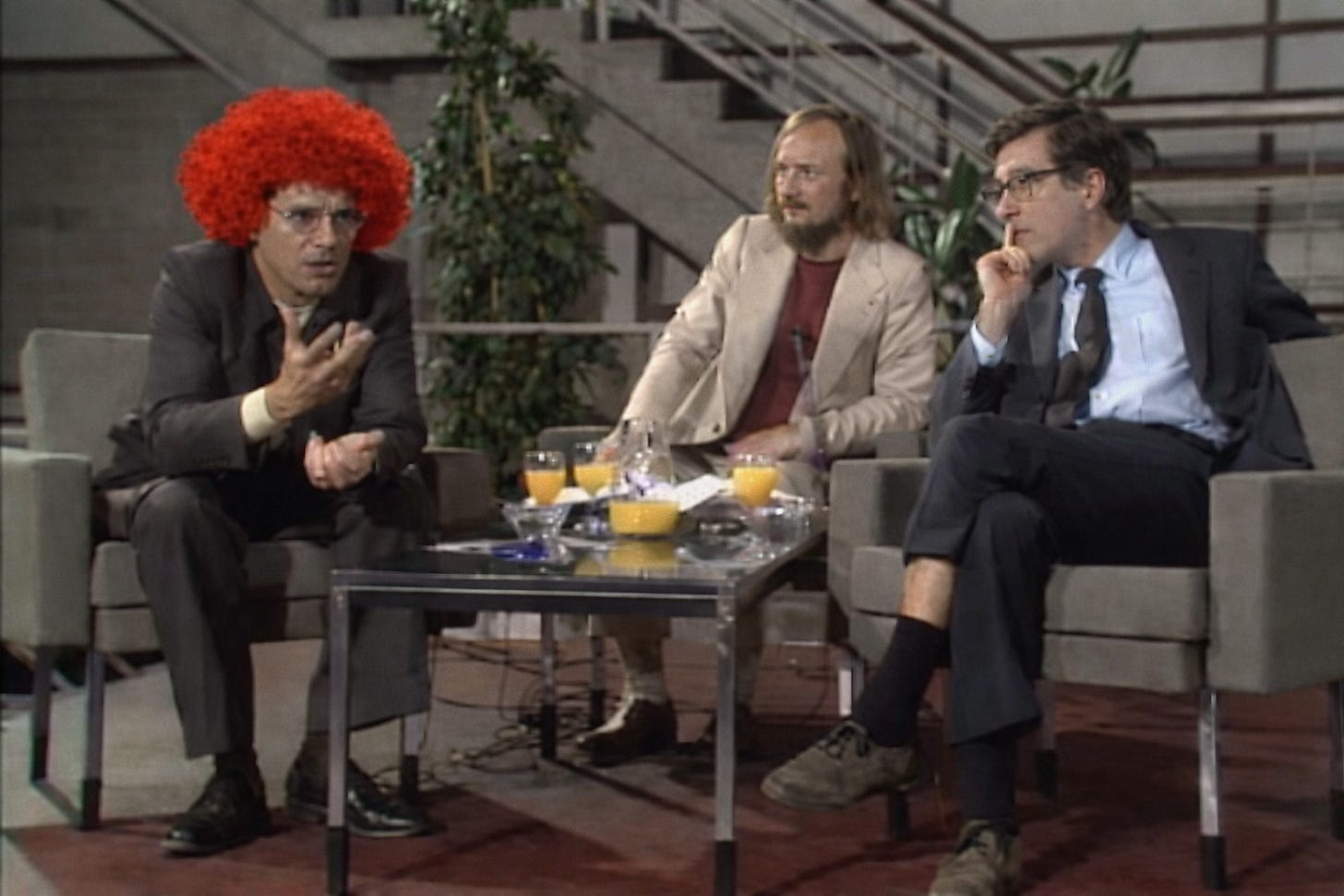
In fact, to gauge how transgressive Foucault could be, the moderator had challenged him to don a large red wig during the debate, as a way of puncturing the deadpan Protestant solemnity of the audience. The accessory was strategically within arm’s reach under the table, but although Elders repeatedly prodded the great French intellectual, whispering “Go for it!,” Foucault demurred and kept his dignity.
When I discuss this legendary debate in my philosophy lectures at Ghent University, my students are always struck by the sheer width of the gulf separating the two titans. Despite their courteous efforts to find common ground, they seem to start from radically incommensurable premises. The moderator ventures a metaphor to bridge the gap: both thinkers are digging a tunnel from opposite sides of a mountain, and somewhere in the middle they will meet and embrace. It’s a suggestive image, but it feels more as though Foucault and Chomsky inhabit different continents. True, both are firmly on the Left — but that’s like saying penguins and polar bears both live in cold climates, yet remain separated by thousands of kilometres. Even at the level of language, they talk past one another. Shortly after the debate begins, Foucault apologizes for his poor English and promptly switches to French, reneging on his agreement with the moderator; from then on, each proceeds in his own language.
[Read the rest of this piece on Substack]